Plan a Stiff Starter Build by Counting the Seed’s Flour and Water
A seed starter already contains flour and water. A target build must include those existing contributions before calculating additions. This guide explains mass balance with illustrative numbers; it does not prescribe a culture-care schedule or fermentation endpoint.
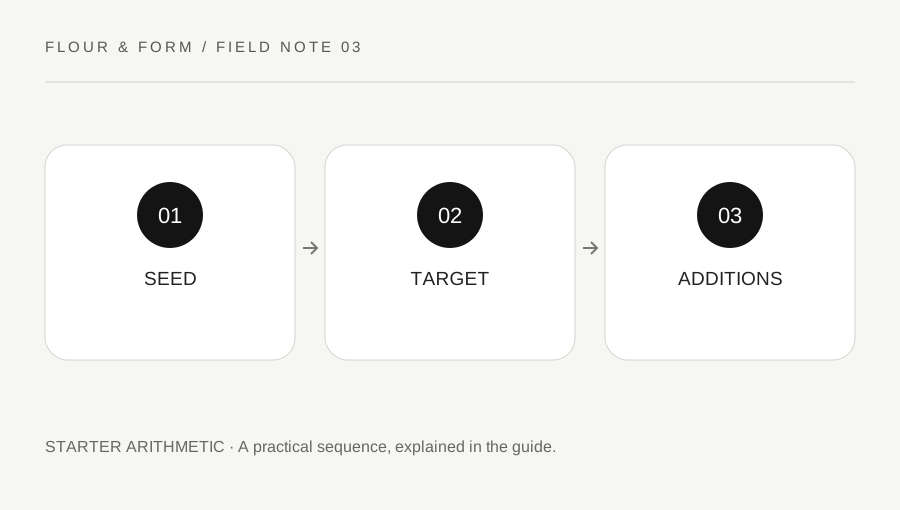
Original explanatory diagram. Examples illustrate a method or decision; they are not claims of personal testing.
Write the seed composition
Record the seed mass and its documented hydration. For a seed containing only flour and water, divide mass by one plus hydration expressed as a decimal to find flour. The remainder is water. If the seed's history or composition is unknown, label that uncertainty instead of calculating a false precise split.
Keep flour types in the record too if the target blend matters. The seed's flour belongs in the overall build, not outside it. A target flour blend can therefore require different added flours from a build that begins with a seed of another composition.
Work through a target build
Suppose a 20-gram seed at one hundred percent hydration contains 10 grams flour and 10 grams water. The illustrative target is a 150-gram build at fifty percent hydration. That target contains 100 grams total flour and 50 grams total water.
Subtract the seed contributions: add 90 grams flour and 40 grams water. The final mass is 20 + 90 + 40 = 150 grams, and hydration is 50 divided by 100, or fifty percent. The seed is counted once. These numbers demonstrate a calculation and are not a validated feeding ratio or a timed baking process.
Check whether the target is possible
An addition-only build cannot remove water or flour already present in the seed. If the target requires less water than the seed contains, the planned target is impossible under that simple model. Change the seed amount, target size or appropriate documented method rather than entering a negative water addition.
Likewise, a target flour total below the seed's flour contribution is not achieved by subtracting a dry ingredient later. Mass balance should reveal such conflicts before mixing. Keep the distinction between mathematical feasibility and a suitable culture-maintenance method; a feasible number alone does not establish good fermentation practice.
Prepare a clear build note
Use rows for seed, added flour, added water and final totals, with flour and water columns. Check each column separately and then the mass sum. Include the target hydration in words so a reader does not confuse fifty percent with a one-to-one water-flour ratio.
For actual preparation, use a suitable verified recipe or culture-care method and its hygiene and readiness guidance. Do not invent a fixed maturity time from the arithmetic. A starter can vary with temperature, flour and condition. Record actual observations after a real build rather than presenting the proposed calculation as tested.
Audit before transferring to the final dough
When the build is used in a bread formula, transfer its flour and water totals into the master formula. Do not count the build mass as flour and then add its water again. If only part of the build is used, apply the same documented composition to that portion.
Keep any retained culture and the amount used for bread as separate quantities. This avoids a plan that assumes every gram is available for the final mix while also expecting some to remain. A short mass-balance table can explain the build clearly without turning it into unsupported claims about taste, fermentation speed or a guaranteed baking result.
A practical checklist
Choices are saved in this browser. Reset them here or clear this site’s browser storage.
Questions that come up
Can I ignore a small seed amount?
For a clear mass balance, count it. Its flour and water are part of the build, even when the practical difference is small.
What if the calculation gives negative added water?
The chosen target cannot be reached by additions alone with that seed amount. Revise the plan using an appropriate documented method.
Does this tell me when the build is ready?
No. Readiness belongs to the verified culture-care or bread method. Arithmetic establishes composition, not an exact fermentation schedule.
References & scope
Background references checked on 18 October 2026. Worked examples and diagrams are original teaching material.