Count Starter Flour and Water in a Sourdough Formula
A starter contributes both flour and water. Separating those components makes total hydration and recipe scaling much clearer.
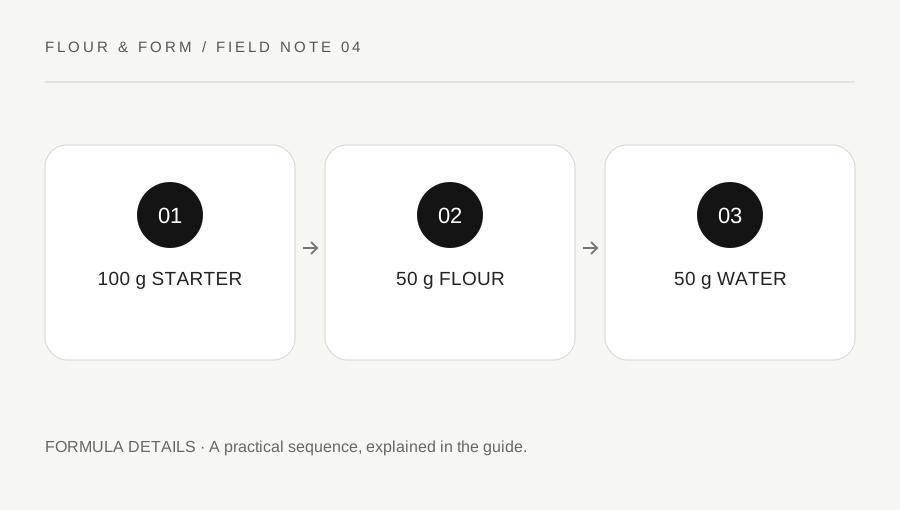
Original explanatory diagram. Numerical examples in this guide illustrate the reasoning; they are not a claim of hands-on testing.
Define the starter hydration
A 100% hydration starter contains equal flour and water by weight. A 100 g portion therefore contributes 50 g flour and 50 g water. That statement is an arithmetic description of the starter, not a feeding recommendation or a promise about its fermentation activity.
For a starter at hydration H expressed as a decimal, flour is starter weight ÷ (1 + H), and water is the remaining weight. A 150 g starter at 50% hydration contains 100 g flour and 50 g water. Check how your recipe defines the starter before using these equations.
Calculate the total dough hydration
Consider a formula with 450 g flour, 300 g water and 100 g of a 100% hydration starter. The starter adds 50 g flour and 50 g water, making 500 g total flour and 350 g total water. Total hydration is therefore 70%, not 300 ÷ 450.
If salt is 10 g, it is 2% of the total 500 g flour. Keep added flour and total flour clearly labeled in your notes. This prevents a common spreadsheet error in which the starter flour disappears from the denominator.
Check the formula before changing it
Write a small ingredient ledger with columns for added flour, starter flour, added water and starter water. Add each column once. If you scale the batch, scale the starter quantity along with the other ingredients and preserve its stated hydration.
The lean yeast-dough calculator on this site does not automatically account for starter. Use this ledger first or a recipe tool explicitly designed for preferments. Fermentation timing and starter readiness are separate practical questions, so follow a reliable sourdough method rather than expecting hydration math to determine when to bake.
Compare added flour with total flour
Write a four-line ledger for a dough containing 400 g added flour, 260 g added water and 200 g of a 100% hydration starter. The starter contributes 100 g flour and 100 g water. Total flour is 500 g, total water is 360 g, and hydration is 72%. If salt is 10 g, it is 2% of total flour.
If you mistakenly divide 260 by 400, you would label the dough 65%. If you add the starter water but forget its flour, you get another incorrect result. The ledger prevents both mistakes by making each component visible. It also helps when a recipe describes one amount as “flour in the final mix” and another as “total flour.”
For a starter with a different stated hydration, split the components using the formula in the first section rather than assuming equal halves. Keep the starter weight, hydration and component totals together when scaling. These calculations do not establish whether the starter is active or ready to use. That practical decision belongs to the complete method, and a mathematically correct ledger cannot replace it.
A practical checklist
Tick items for your own use. This checklist is saved only in this browser.
Questions that come up
Does 100% hydration mean the starter is all water?
No. It means water weight equals flour weight. A 100 g portion contains 50 g of each.
Can I use this method for a stiff starter?
Yes, if its hydration is known. Divide starter weight by one plus its hydration as a decimal to find its flour contribution.
Does starter hydration tell me its activity?
No. Hydration describes a weight relationship. Readiness and fermentation behavior require separate observation and recipe guidance.
References & scope
Background references checked on 18 October 2026. The examples and practice exercises are original editorial explanations, not copied procedures or professional advice.