Baker’s Percentage Explained with a Complete Worked Formula
Baker’s percentage expresses each ingredient against the total flour weight. Flour is always 100%, so the formula stays understandable when the batch changes.
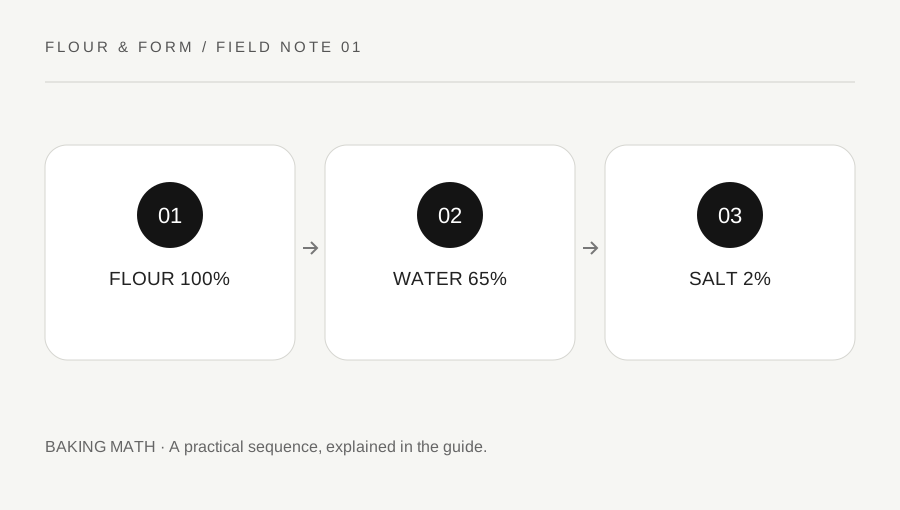
Original explanatory diagram. Numerical examples in this guide illustrate the reasoning; they are not a claim of hands-on testing.
Build the flour reference first
Add all the flour in the formula before calculating percentages. For a simple dough with 400 g white flour and 100 g whole-grain flour, the reference is 500 g total flour. Water at 325 g is 325 ÷ 500 × 100 = 65%. Salt at 10 g is 2%.
The percentages do not need to total 100. They describe relationships to flour, not shares of the finished dough. In the example, flour, water and salt already total 167% before any yeast or other ingredients. This is the most common point of confusion when moving from ordinary percentages to baker’s math.
Scale the complete formula
Suppose an illustrative lean-dough formula uses flour 100%, water 65%, salt 2% and yeast 1%. At 500 g flour, those quantities are 500 g, 325 g, 10 g and 5 g, for 840 g total dough. This is a calculation example, not a tested recipe or fermentation schedule.
To make 1,260 g of that same formula, multiply every quantity by 1.5. Alternatively divide target dough by 1.68 to get 750 g flour, then calculate the other ingredients from it. Scaling only the flour would change the formula rather than enlarge the batch.
Recognize what the math does not decide
Ingredient proportions do not determine mixing time, fermentation readiness, bake time or pan capacity on their own. Flour type, temperature, dough handling and equipment still matter. Use a complete, reliable recipe for the practical method, then use baker’s percentages to understand its structure.
When a formula includes a starter or preferment, include its flour and water in the totals. Our starter worksheet explains that calculation separately. Do not count the starter once as an ingredient and again as extra flour without reconciling the totals; that would misstate both batch weight and hydration.
Work backward from a dough target
Use a hypothetical formula with flour 100%, water 70%, salt 2% and dry yeast 0.5%. The total is 172.5%, or a multiplier of 1.725. To target 1,035 g of dough, divide 1,035 by 1.725. That gives 600 g flour. The other quantities are 420 g water, 12 g salt and 3 g yeast. Add them: 600 + 420 + 12 + 3 = 1,035 g.
Now separate the mathematical result from the practical bake. The calculation says nothing about whether that dough fits your pan, whether the yeast quantity matches a particular fermentation plan or whether your flour suits the hydration. Those questions belong to a complete recipe and method.
When recording your own formula, use two columns: baker’s percentage and actual grams. A third column can describe the ingredient precisely, such as flour type or yeast type. This prevents a later baker from assuming that every product with the same broad name behaves identically. Keep the total percentage visible so you can reconstruct the batch calculation. If the sum of the ingredient weights does not match the expected total, check the arithmetic before changing the recipe.
A practical checklist
Tick items for your own use. This checklist is saved only in this browser.
Questions that come up
Why do the percentages add to more than 100?
Flour is the reference at 100%. Every other ingredient is an additional percentage of that flour weight.
Is 2% salt a requirement for every bake?
No. It is part of an illustrative formula here. Use the complete recipe and its intended method rather than treating an example percentage as a universal recommendation.
What is the easiest arithmetic check?
Add all ingredient weights and compare with the target. Then divide each weight by total flour to confirm that the intended percentages were preserved.
References & scope
Background references checked on 18 October 2026. The examples and practice exercises are original editorial explanations, not copied procedures or professional advice.