Scale a Bread Recipe by Batch Weight Without Losing the Formula
A scale factor changes ingredient quantities together. Capacity, timing and practical handling still need a separate check.
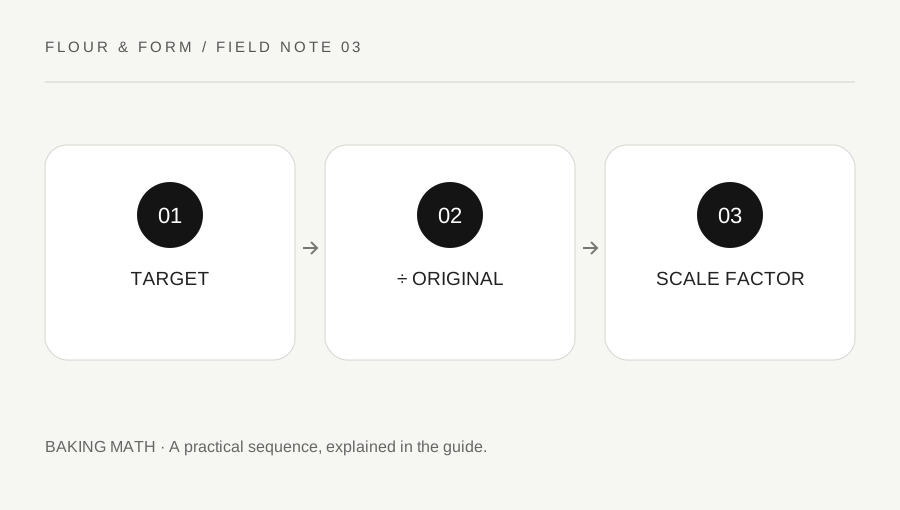
Original explanatory diagram. Numerical examples in this guide illustrate the reasoning; they are not a claim of hands-on testing.
Choose the correct starting total
Write down every ingredient and add their weights. If a complete formula makes 900 g of dough and you want 1,350 g, the factor is 1,350 ÷ 900 = 1.5. Multiply every ingredient by 1.5, including small ingredients such as salt and yeast.
Do not use the baked loaf weight as the dough total. Moisture is lost during baking, and the difference is not fixed across methods. If your target is a particular finished loaf size, begin with a recipe designed for the intended pan and use its dough weight as your reference.
Round with care
Keep enough precision for small ingredients. Rounding 6 g of salt to 10 g changes a small batch substantially. If your scale cannot weigh the required quantity reliably, make a more practical batch size or use a suitable scale rather than guessing.
Check your arithmetic by adding the scaled ingredients and comparing the result with the target. A small difference caused by deliberate rounding should be recorded. The batch calculator shows both flour-based and target-dough modes so you can inspect the relationship rather than rely on a number without context.
Recheck the physical batch
A larger batch may exceed your mixer, bowl, proofing container or oven capacity. A smaller piece of dough can behave differently in an oversized pan. Divide the dough into appropriately sized pieces when the original method supports that approach.
Do not multiply fermentation or bake time by the ingredient scale factor. Temperature, dough size and the method affect those stages. Keep the recipe’s readiness cues and temperature guidance, and plan how the changed quantity fits your equipment. Scaling the formula is one step in adapting a bake, not the whole adaptation.
Plan equal dough pieces without hiding rounding
Suppose a formula makes 840 g of dough and you want three pieces of 350 g each. The target is 1,050 g, so the scale factor is 1,050 ÷ 840 = 1.25. A 500 g flour quantity becomes 625 g, 325 g water becomes 406.25 g, 10 g salt becomes 12.5 g and 5 g yeast becomes 6.25 g.
Decide how to round based on your equipment. If the scale supports only whole grams, record the quantities you actually use and add the rounded total. Do not display quarter-gram precision in a final record if it was not measured. For very small ingredients, choosing a different practical batch size may give you more reliable quantities.
Finally, check the physical division. A total dough target does not include an allowance for material left on tools or in the bowl. If equal piece weights are important, weigh the actual dough after mixing and divide what you have consistently. Keep piece size appropriate to the original recipe method and your equipment. The arithmetic is transparent, while the practical planning remains a separate decision rather than an unspoken assumption.
A practical checklist
Tick items for your own use. This checklist is saved only in this browser.
Questions that come up
If I double a recipe, do I double the baking time?
No. Ingredient scaling does not provide a bake-time multiplier. Follow the method and assess the size and readiness of the actual pieces.
Should I round every ingredient before multiplying?
Preserve the original numbers during calculation and round final quantities deliberately. Early rounding can compound across a formula.
Can I scale by flour weight instead?
Yes. Choose the new flour weight, calculate its ratio to the old flour weight and multiply every other ingredient by the same factor.
References & scope
Background references checked on 18 October 2026. The examples and practice exercises are original editorial explanations, not copied procedures or professional advice.