Bread Hydration: Calculate Water and Understand the Limits
Hydration is a useful ratio for comparing dough formulas. It is not a complete prediction of how a dough will feel or how a loaf will turn out.
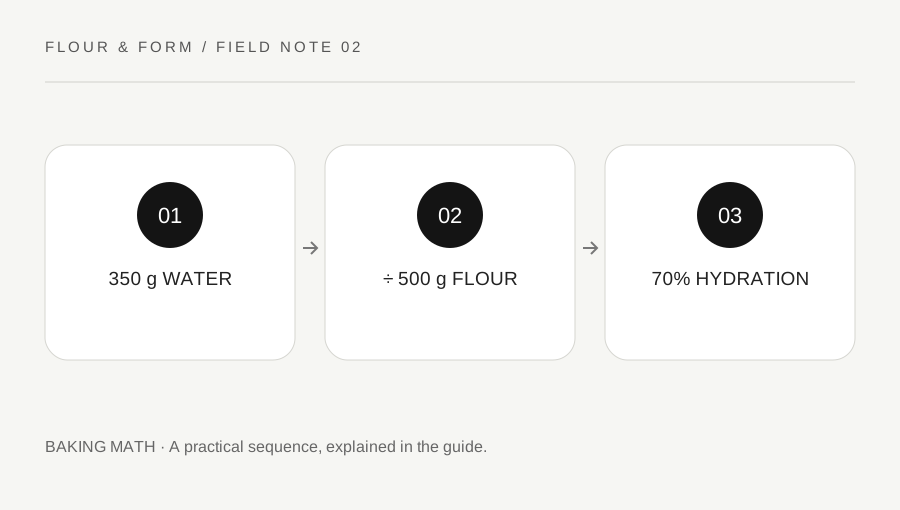
Original explanatory diagram. Numerical examples in this guide illustrate the reasoning; they are not a claim of hands-on testing.
Calculate the simple version
For a lean flour-and-water dough, divide water weight by total flour weight and multiply by 100. With 350 g water and 500 g flour, hydration is 70%. With 650 g flour at a target of 68%, water is 650 × 0.68 = 442 g.
Use weights in the same unit. A cup of flour and a cup of water do not weigh the same amount, so dividing their volumes will not produce the same ratio. A scale makes both the calculation and the next batch easier to reproduce.
Compare like with like
Two doughs at 70% can handle differently because their flours, milling, additions and processing differ. A number alone cannot tell you whether to add a handful of flour or whether the dough is ready for shaping. Compare formulas with their full ingredients and methods beside them.
Milk, eggs and syrups contain components beyond water. Treating their complete weight as pure water can give a misleading comparison. The calculator on this site is for a lean flour-water-salt-yeast formula; it deliberately does not claim to calculate the true water content of an enriched dough.
Use a small controlled change
Start with a reliable recipe that already works in your kitchen. If you choose to compare hydration, keep flour, batch size and method as similar as practical. For 500 g flour, a two-percentage-point change is 10 g water, not 2 g.
Record the original and changed formula, dough temperature if available and how the dough behaves during mixing and shaping. Label the experiment as an adaptation. Do not describe an untested hydration change as a guaranteed improvement; your result depends on ingredients and technique as well as the arithmetic.
Read a hydration change in grams
Begin with 600 g flour and 390 g water. The hydration is 65%. Moving to 67% would require 600 × 0.67 = 402 g water, a difference of 12 g. Moving to 70% would require 420 g, a difference of 30 g. Writing those differences in grams makes the size of the experiment easier to understand.
If your formula includes a starter, calculate total flour and water before making that comparison. For example, adding an uncounted 100 g starter changes the denominator as well as the water total. A seemingly small arithmetic omission can therefore mislabel the entire dough.
During a practical comparison, note what you had to change to handle the dough. If you added flour during shaping without recording it, the final formula is no longer the planned one. That does not make the loaf worthless, but it limits what you can conclude about the chosen hydration. Record the adaptation honestly and repeat the experiment more carefully if the question still matters. A useful note describes both the intended ratio and what actually happened at the bench.
A practical checklist
Tick items for your own use. This checklist is saved only in this browser.
Questions that come up
Does higher hydration always make better bread?
No. The appropriate hydration depends on the flour, method and desired result. Higher is not a quality score.
Is hydration the percentage of water in the total dough?
Not in baker’s percentage notation. It is water weight divided by flour weight, multiplied by 100.
Why do two 70% doughs feel different?
Flour composition, milling, additions, mixing and rest can differ. Compare the complete formulas and methods rather than only the hydration label.
References & scope
Background references checked on 18 October 2026. The examples and practice exercises are original editorial explanations, not copied procedures or professional advice.