Measure Small Baking Amounts Within the Scale’s Useful Range
A scale displaying decimals is not automatically accurate for every tiny amount. Read its range, resolution and instructions, then choose a suitable measuring method for the recipe. Keep display precision separate from a claim about measurement accuracy.
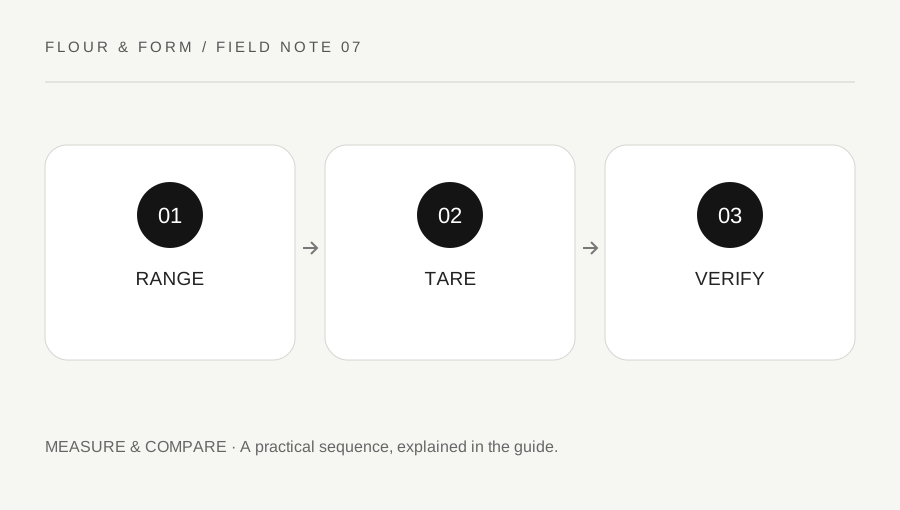
Original explanatory diagram. Examples illustrate a method or decision; they are not claims of personal testing.
Read the scale specification
Find the maximum capacity, displayed increment and any stated minimum or accuracy information. Resolution describes the display step; it does not alone prove the true value is within that step. Use the maker's instructions for setup, checking and calibration where applicable.
Place the scale on a stable suitable surface, away from interference the instructions identify. Check the unit before measuring. A flour amount in grams and a scale left in ounces can produce a plausible-looking but incorrect number. Keep the recipe's original units visible while preparing ingredients.
Use tare deliberately
Place the intended container, tare as directed and add the ingredient gradually. Do not assume repeated taring can repair drift or an unsuitable minimum amount. A large heavy container can also reduce the remaining capacity available for the ingredients.
For a very small quantity, use a scale or measuring method suitable for that amount and the verified recipe. Do not invent an arbitrary spoon conversion when the ingredient's density and method are unknown. If the recipe offers a tested alternative measurement, keep that exact convention rather than mixing it with an unrelated table.
Work through a displayed-rounding example
Imagine a scale that displays whole grams. An intended 2.4-gram amount cannot be represented exactly on that display. A reading of 2 grams does not show whether the actual amount is precisely 2.0. This is a measurement limitation, not a reason to assume all small ingredients are unimportant.
Use an appropriate verified method or suitable scale instead of repeatedly adding and removing tiny pinches while trusting an unstable display. Keep safety-critical and recipe-sensitive quantities under their proper guidance. This article does not prescribe a universal adjustment for yeast, salt or another ingredient.
Avoid unsupported batch shortcuts
Multiplying a recipe solely to make a tiny ingredient easier to weigh changes the batch size and equipment needs. If you use a supported larger batch, calculate all ingredients and process requirements, not just the small one. Do not make an unapproved premix or dilution without appropriate formulation guidance.
For ordinary kitchen planning, the simplest solution may be a suitable measuring tool or a verified recipe expressed in quantities your equipment can handle. Accurate-looking arithmetic cannot compensate for an unsuitable measurement method.
Keep a measurement note that explains limits
Record the scale model or useful specification, unit, container and intended amount when a small measurement is central to an experiment. Mark an unresolved limitation clearly. Do not report several decimal places in a baking log when the instrument did not support them.
If a bake differs, inspect measuring conditions before blaming the formula. A missed tare or wrong unit can be a more direct explanation than a complex fermentation theory. The goal is an honest repeatable measurement process that supports a verified recipe, not a display filled with digits that imply precision the equipment never established.
Check that the display has settled according to the instructions before recording a value. If readings drift unexpectedly, investigate the setup or equipment instead of selecting whichever number most closely matches the planned formula.
A practical checklist
Choices are saved in this browser. Reset them here or clear this site’s browser storage.
Questions that come up
Does a 0.1-gram display guarantee 0.1-gram accuracy?
No. Read the maker’s accuracy and operating specifications. Resolution alone does not establish the measurement uncertainty.
Can I convert every small weight to teaspoons?
Not reliably without an appropriate ingredient-specific convention or verified recipe. Density and filling method matter.
Should I multiply the recipe to weigh a tiny amount?
Only use a suitably supported larger process with all equipment and ingredient changes accounted for. A measuring-tool decision should not silently create an unverified batch.
References & scope
Background references checked on 18 October 2026. Worked examples and diagrams are original teaching material.