Round a Scaled Bread Formula Without Losing Track of the Total
A scaling calculation can produce more decimal places than a kitchen scale can use. Keep the exact calculation separate from the chosen measuring amounts, then check the rounded totals. Rounding is a documented practical decision, not a reason to hide discrepancies.
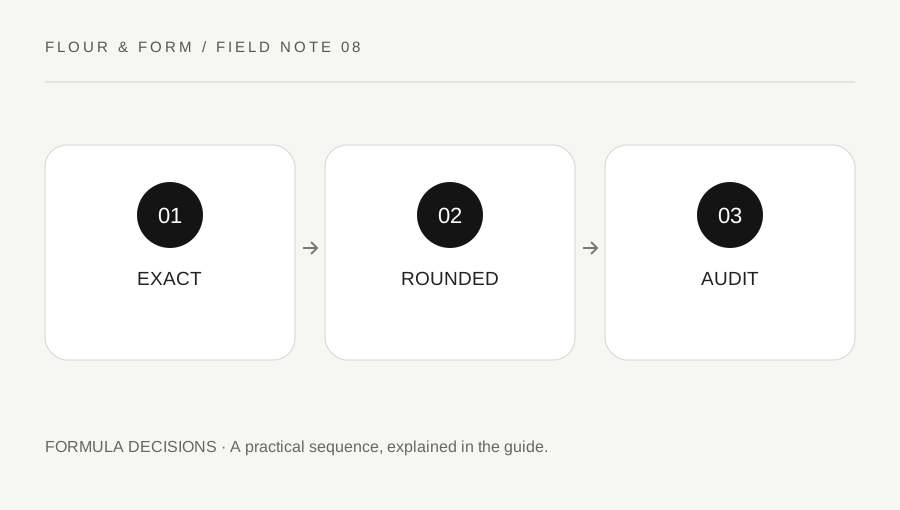
Original explanatory diagram. Examples illustrate a method or decision; they are not claims of personal testing.
Calculate before rounding
Use the original formula and a consistent scaling factor to calculate each ingredient. Preserve those values in a calculation column. If you round each intermediate step early, the final total can drift in a way that is difficult to trace.
Choose the measuring increment according to suitable equipment and the recipe. A large flour amount and a very small ingredient may need different practical handling. Do not assume every row can be rounded to the same increment without considering its role and the available measuring method.
Use a simple numerical example
An illustrative formula has flour at one hundred percent, water at seventy percent and salt at two percent. Its total is 172 percent. For a 1,000-gram mathematical dough target, flour is 1,000 divided by 1.72, approximately 581.395 grams. Water is approximately 406.977 grams and salt approximately 11.628 grams.
Rounding those rows to 581, 407 and 12 grams gives 1,000 grams total. This convenient sum is an example, not a general guarantee that independent rounding will preserve every target. It is also not a complete tested bread recipe or a process recommendation.
Check the rounded formula
Add the chosen measuring amounts and compare them with the target. Recalculate the resulting ingredient percentages if the difference matters to the intended comparison. A one-gram total discrepancy is not automatically a failure, but it should not be concealed by silently changing a row.
If an adjustment is appropriate under the recipe and measurement context, record which amount changed and why. Do not alter a small recipe-sensitive ingredient solely to make the arithmetic sum look tidy. The displayed total is one constraint among the actual formulation and measurement requirements.
Keep rounding distinct from process validation
Rounded quantities do not establish mixing, fermentation or baking times. The verified method and equipment still govern preparation. A mathematical batch target also does not prove that a pan can hold that amount.
When comparing bakes, use the actual measured amounts where available rather than reporting only the theoretical unrounded formula. If the scale could not resolve a tiny difference, mark that limitation. Honest measurement notes are more informative than a falsely exact published percentage.
Build a two-column kitchen sheet
Keep exact calculated weight and intended measuring weight side by side, with a final total for each. Add a note for any special small-quantity measurement. This lets another person audit the proportional calculation without confusing it with the practical scale display.
Before mixing, check units, ingredient identity and every stage contribution. After an actual bake, record observations separately. A good rounding sheet explains what was calculated, what was intended to be measured and what was actually used, preserving the distinction instead of rewriting the numbers to make an outcome appear more controlled than it was.
For an additional arithmetic check, use a 500-gram target with the same illustrative 172-percent total. Exact flour is about 290.698 grams, water about 203.488 grams and salt about 5.814 grams. A practical plan must state how each is measured; simply printing these decimals does not make the scale capable of resolving them. Add the selected measuring amounts and compare the result with 500 grams before mixing. Keep any difference visible. This small example is useful because independent rounding can produce a nearby total without preserving every original ratio exactly. Choose a suitable verified recipe and measuring method rather than treating neat arithmetic as a reason to change the process.
A practical checklist
Choices are saved in this browser. Reset them here or clear this site’s browser storage.
Questions that come up
Must rounded amounts add to the exact target?
Not automatically. Check the difference and decide appropriately within the recipe and measurement context. Do not change a sensitive ingredient merely to tidy the sum.
Can I round every ingredient to whole grams?
Use suitable equipment and recipe guidance for the actual amount. Very small quantities can need a different method.
Do decimal calculations make the recipe tested?
No. Accurate arithmetic describes quantities. It does not validate the preparation process or establish personal test results.
References & scope
Background references checked on 18 October 2026. Worked examples and diagrams are original teaching material.