Prefermented Flour Percentage Is Different from Starter Weight Percentage
A starter contains flour and water. Its total weight is therefore a different quantity from the flour it contributes. When comparing formulas, state whether a percentage describes starter mass or prefermented flour, and use the same denominator throughout.
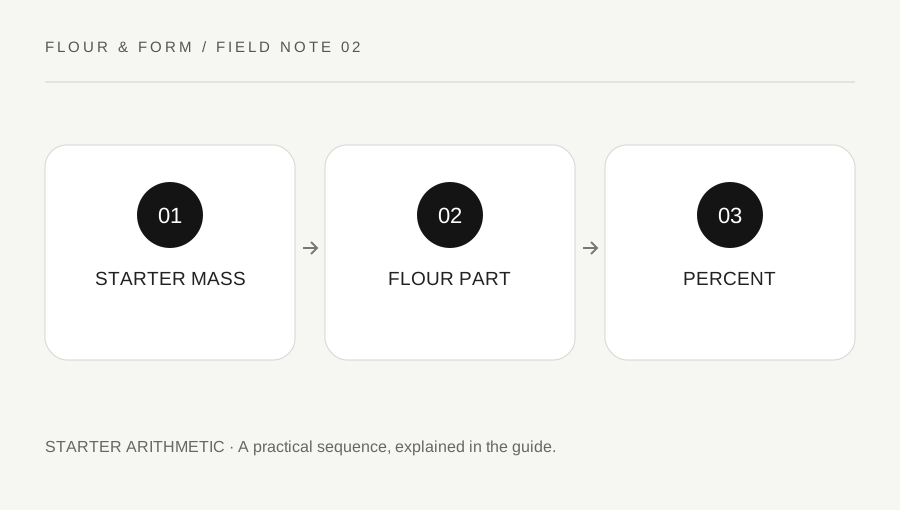
Original explanatory diagram. Examples illustrate a method or decision; they are not claims of personal testing.
Name the quantity being compared
Starter weight percentage commonly compares total starter mass with total flour, while prefermented flour percentage compares the flour inside the preferment with total formula flour. Those can be different numbers for the same dough. A percentage without its numerator is easy to misread.
Also confirm whether a source uses final-mix flour or total formula flour as its denominator. This guide uses total flour across all stages. Keep another source's convention intact when reading it, then translate explicitly if needed. Do not combine numbers from two conventions and assume the resulting comparison is meaningful.
Work through a liquid-starter example
An illustrative 200 grams of starter at one hundred percent hydration contains 100 grams flour and 100 grams water. If total formula flour is 500 grams, the starter mass is forty percent of flour, while prefermented flour is twenty percent. The two percentages describe different numerators.
The final mix must account for the starter's flour and water contributions. If the target total water is 350 grams, the starter supplies 100 grams and the remaining addition is 250 grams, assuming no other water-bearing stages. This arithmetic does not specify fermentation time or a complete tested recipe.
Compare a stiffer preferment carefully
The same starter mass can carry a different flour amount at another hydration. For hydration expressed as a decimal h, flour equals starter mass divided by one plus h, and water equals mass minus that flour. At fifty percent hydration, 150 grams contains 100 grams flour and 50 grams water.
Thus 150 grams of that stiffer preferment and 200 grams of a one-hundred-percent-hydration starter can contribute the same flour amount. Comparing their mass percentages alone would obscure that similarity. Their process behavior can still differ; the calculation does not make the builds interchangeable in a recipe.
Keep labels beside the numbers
Use separate columns for starter mass, starter hydration, starter flour, starter water and total formula flour. Calculate prefermented flour percentage from the flour column. If a stage includes other ingredients, use its documented composition rather than assuming it contains only flour and water.
When sharing a formula, write the exact convention in the heading. A note saying twenty percent starter can be ambiguous without hydration and denominator. A transparent table makes the intended comparison easier than a debate over terminology detached from the actual weights.
Check a comparison before changing a process
Take two formula notes and normalize their flour totals to the same convenient amount, such as 500 grams. Calculate each preferment's flour contribution and compare those percentages. Then compare total water and the stated process separately. This prevents a larger wet starter mass from being mistaken automatically for more prefermented flour.
Do not infer a guaranteed rise time, sourness or finished texture from this percentage alone. Temperature, flour, culture condition and the recipe's method matter. Use a verified recipe for actual preparation and label a numerical comparison as analysis rather than a personal baking test.
When a source uses a different definition, quote the term only briefly and retain its stated denominator in your notes. Translate the actual weights explicitly rather than assuming terminology is uniform across all baking writers.
A practical checklist
Choices are saved in this browser. Reset them here or clear this site’s browser storage.
Questions that come up
Are twenty percent starter and twenty percent prefermented flour equivalent?
Usually they describe different quantities. A starter includes water, so its mass is not identical to its flour contribution. Hydration and denominator must be known.
Can equal starter masses contain different flour amounts?
Yes. Different hydrations change the flour-water split. Use the documented composition instead of assuming every starter is half flour.
Does the percentage predict an exact fermentation time?
No. It is one formula descriptor among several. Follow a suitable verified method and observe the actual dough rather than treating a percentage as a timer.
References & scope
Background references checked on 18 October 2026. Worked examples and diagrams are original teaching material.