Scale a Formula Around a Limited Ingredient Without Ignoring the Rest
Sometimes the available ingredient amount is the constraint rather than desired dough weight. Solve that row for total flour, then calculate the remaining formula. Check every other ingredient and equipment limit before assuming the mathematically possible batch can be made.
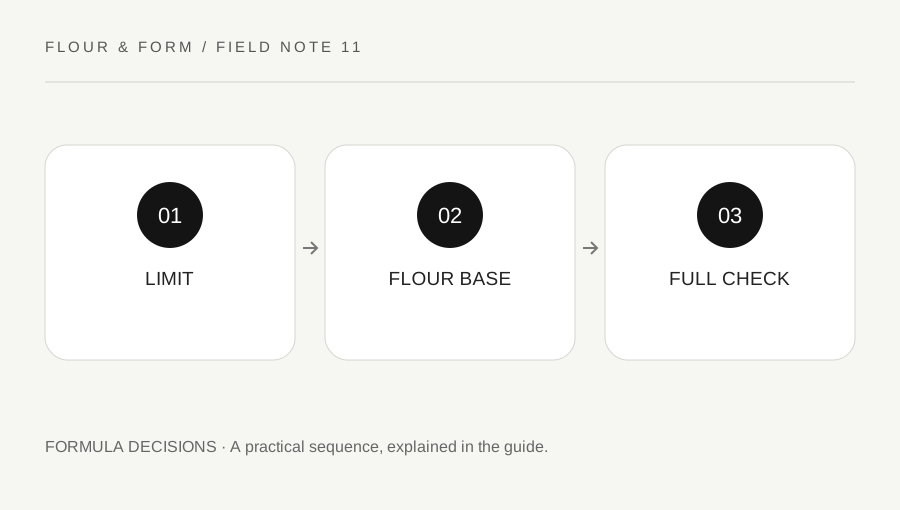
Original explanatory diagram. Examples illustrate a method or decision; they are not claims of personal testing.
Identify the limiting row
Write the available usable amount and the ingredient's baker's percentage in the verified formula. Use a nonzero percentage and consistent units. Do not confuse an ingredient's percentage of flour with its percentage of the whole dough.
If several ingredients are limited, calculate a possible flour base from each and identify the smallest supported scale. A single abundant ingredient does not make the rest available. Keep any ingredient reserved for another purpose out of the usable amount rather than planning to use the entire container automatically.
Work through a water-limited example
In an illustrative formula with water at seventy percent of flour, 280 grams available water corresponds to 400 grams flour because 280 divided by 0.70 is 400. If salt is two percent, its calculated amount is 8 grams. The three-row mathematical total is 688 grams.
These numbers demonstrate the inverse calculation, not a complete tested recipe. If the formula includes starter or other water contributions, count them in the correct totals. The amount of added water available and the target total formula water can be different quantities.
Check the remaining constraints
Confirm that all calculated ingredients are available and can be measured suitably. Check the verified recipe's batch limits, mixer, pan and handling instructions. A very small scaled amount of one ingredient may fall outside the useful range of your measuring equipment.
Do not replace a missing ingredient casually just to complete the arithmetic. A substitution changes the formula and may need a different supported method. The useful result can be a smaller batch or a decision to choose another verified recipe.
Keep batch size and process separate
Changing ingredient quantities does not establish a proportional change in fermentation or baking time. Piece size, temperature and equipment can matter. Follow suitable recipe guidance for the actual batch and portion arrangement.
Label the calculation as a plan until it is prepared. A spreadsheet that balances does not constitute a baking test. After a genuine session, record the actual measured amounts, equipment and observations separately so a later comparison is based on what happened rather than the theoretical target alone.
Use a complete constraint note
Write the limiting ingredient, usable amount, formula percentage, derived flour base and all remaining weights. Add a line for equipment and measurement checks. If several limits exist, show the alternative derived bases and the reason for choosing the final one.
This is more transparent than scaling a recipe repeatedly by guesswork. It also makes the denominator visible when someone else checks the arithmetic. Keep the original recipe and its process intact, and use the calculation to choose a feasible supported quantity rather than claiming it validates a new formulation or ingredient substitute.
If flour is limited to 350 grams while the available water would support 400 grams at the illustrative seventy-percent ratio, flour is the tighter constraint. The corresponding listed water is 245 grams and two-percent salt is 7 grams. The three-row mathematical total is 602 grams. Check all other rows in the actual recipe before adopting that scale. This example shows why solving one limited ingredient is not enough when several supplies or equipment capacities impose limits. A clear constraint table makes the chosen batch explainable and prevents an abundant ingredient from driving a plan that another row cannot support.
A practical checklist
Choices are saved in this browser. Reset them here or clear this site’s browser storage.
Questions that come up
What if starter already supplies some water?
Count all stage contributions. Available added water is not necessarily the same as the formula’s total water.
Can I substitute another ingredient when one is missing?
Only use an appropriate supported substitution or recipe. A balanced quantity calculation does not establish that ingredients are interchangeable.
Should fermentation time scale by the same factor?
No general proportional rule follows from ingredient scaling. Use suitable verified process guidance and actual observations.
References & scope
Background references checked on 18 October 2026. Worked examples and diagrams are original teaching material.