Divide Dough into Equal Portions: Choose Count or Piece Weight First
A portioning plan needs either a desired number of pieces or a desired piece weight. Those are different starting constraints. Weigh the usable dough at the stated stage and keep any planned remainder visible rather than assuming the bowl’s original formula mass is all available.
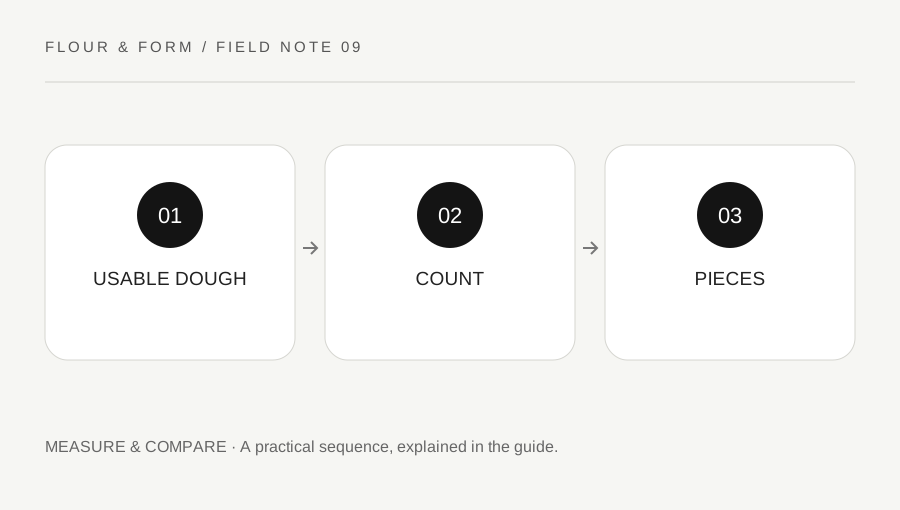
Original explanatory diagram. Examples illustrate a method or decision; they are not claims of personal testing.
Weigh the available dough
Use a suitable clean food-contact container and scale procedure. Record the net dough weight after the stage from which you will divide it. Material remaining in bowls or on tools can make this differ from the theoretical ingredient sum.
Keep the verified recipe's handling and hygiene instructions. The portioning calculation does not determine readiness, proofing or baking. A changed piece size can need a supported process adjustment, so do not assume equal arithmetic alone validates a different roll shape or pan arrangement.
Calculate from a desired count
For an illustrative 1,020 grams of usable dough divided into twelve pieces, the target is 85 grams each. Check multiplication: twelve times 85 returns 1,020. If the division produces a fraction beyond the scale's useful range, choose a documented practical plan rather than pretending every piece is exact to many decimals.
You can distribute a small remainder among pieces where appropriate, keeping the intended uniformity clear. Do not repeatedly overwork the dough simply to chase an unsupported display precision. Follow the recipe's handling method and keep the work manageable.
Calculate from a desired piece weight
If the same 1,020 grams is intended for 80-gram pieces, twelve complete pieces use 960 grams and leave 60 grams. That remainder should be planned deliberately. It is not a thirteenth equal piece, and ignoring it does not make the original count calculation correct.
Choose whether to change the count, alter the target piece size within a supported recipe or use an appropriate separate portion. Keep any smaller piece's baking guidance separate. A piece of different size can behave differently, so do not assume it shares the same endpoint merely because it came from the same dough.
Check the tray or pan arrangement
Equal pieces still need the intended spacing and vessel. A larger count can crowd a tray even when each piece matches the planned weight. Use the verified recipe and equipment guidance for arrangement and baking rather than scaling the number of pieces beyond available space.
Record whether the target is raw dough-piece weight or cooled baked weight. Those are not interchangeable because mass can change during baking and cooling. A finished-weight goal needs a separate explicitly assumed yield estimate, not a silent substitution.
Make a portioning record
Write usable dough weight, desired count or piece size, calculated target, practical measuring plan and remainder. After dividing, compare the sum of measured pieces with the available dough, allowing for actual handling losses you observed.
For a real repeat, keep the chosen piece size and tray arrangement with the recipe. Do not claim the calculation proves a particular baking time or finished texture. Its useful role is making the portion count and remaining dough understandable before the preparation moves to the next verified stage.
Check a second count using the same 1,020-gram teaching total: fifteen equal pieces would be 68 grams each. That is a different portion plan from twelve 85-gram pieces, although both use the same total. The tray arrangement and supported baking process must suit the chosen size. If the actual usable dough turns out to be 1,005 grams, recalculate from that observation instead of forcing the planned weights and hiding the shortfall. Record whether the difference came from an actual measurement or an estimate of bowl residue. A count calculation stays useful when its starting mass and intended piece stage are clear.
A practical checklist
Choices are saved in this browser. Reset them here or clear this site’s browser storage.
Questions that come up
Does a remainder count as another equal roll?
No. State its weight and plan it separately or revise the portioning plan appropriately. Equal count and equal piece weight must agree with the available total.
Can I use the formula’s total instead of weighing?
It can be a planning value, but actual usable dough may differ because of material left on equipment. Label an estimate as an estimate.
Does equal weight guarantee identical baking?
No. Shape, arrangement, recipe and equipment still matter. Use the supported method and its endpoint guidance.
References & scope
Background references checked on 18 October 2026. Worked examples and diagrams are original teaching material.