Compare Two Bread Formulas on the Same Flour Basis
A larger recipe can look wetter or saltier simply because all its ingredient weights are larger. Normalize both formulas to the same total flour before comparing their ratios. Keep ingredient identity, stage contributions and the process separate from the arithmetic.
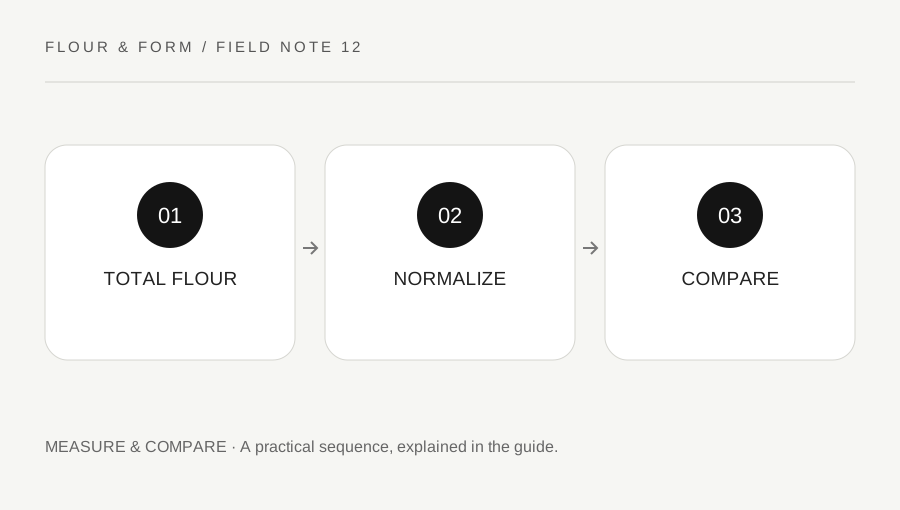
Original explanatory diagram. Examples illustrate a method or decision; they are not claims of personal testing.
Collect complete formulas
Include flour and water inside starters and preferments, not only final-mix additions. Record other ingredients and their preparation state. A formula missing the starter's hydration cannot support a precise total-water comparison without an explicit assumption.
Read the source convention before converting. Some recipes describe a practical liquid percentage while others estimate actual water contributions from enriched ingredients. Do not compare unlike conventions as if they were the same measurement.
Use a common flour amount
An illustrative formula A has 500 grams flour and 350 grams water, giving seventy-percent hydration. Formula B has 800 grams flour and 520 grams water, giving sixty-five percent. Comparing 350 with 520 alone would obscure the ratio difference.
Normalize B to 500 grams flour using a factor of 500 divided by 800, or 0.625. Its water becomes 325 grams. On the common basis, A has 25 grams more listed water. These are teaching formulas, not tested recipes or a promise about which dough will feel softer.
Compare more than one row
Normalize salt and other ingredients using the same factor. Keep flour blends visible too: two formulas can share a hydration number while using different flours. A preferment's flour percentage and hydration can also differ.
Use a table with original weight, normalized weight and baker's percentage for each formula. Do not silently omit an ingredient because it complicates the comparison. If a composition value is unknown, label the limitation rather than filling in a convenient default.
Avoid performance conclusions the numbers cannot support
Temperature, flour properties, mixing and fermentation can affect the actual result. A five-point hydration difference is a formula descriptor, not a complete explanation of crumb or handling. Keep the source methods with the tables.
If you want to compare actual bakes, use appropriate verified methods and document real observations. Do not claim a personally tested preference from reading two ingredient lists. The calculation can identify a useful question without answering every practical baking question.
Write a fair comparison summary
State the common flour basis, the exact quantities compared and any assumptions about starters or other liquids. Describe differences in plain units as well as percentages where useful. A sentence such as A lists 25 grams more water per 500 grams flour is easier to audit than a vague claim that A is much wetter.
Keep process differences in a separate paragraph. This preserves the value of normalization while preventing it from becoming an unsupported ranking. Another baker should be able to reproduce the arithmetic and see which questions remain unresolved before choosing a suitable recipe to prepare.
Add an explicit difference column only after normalization. For the teaching pair, water differs by 25 grams per 500 grams flour, or five percentage points. Five percentage points is not the same wording as five percent more water relative to the lower amount. Relative to 325 grams, the extra 25 grams is approximately 7.69 percent. State which comparison you mean and avoid switching denominators mid-sentence. This small language check matters when formulas are discussed publicly: the weights may be correct while an ambiguous percentage description still misleads the reader about the size of the change.
A practical checklist
Choices are saved in this browser. Reset them here or clear this site’s browser storage.
Questions that come up
Can I compare water grams directly across different batch sizes?
Not meaningfully without the flour basis. Normalize or calculate the stated percentages first.
Does higher listed hydration guarantee a softer dough?
No. Flour, other ingredients and process matter. The ratio alone is not a complete handling prediction.
What if a starter composition is missing?
Mark the comparison as incomplete or use a clearly labeled assumption. Do not present an invented split as exact source data.
References & scope
Background references checked on 18 October 2026. Worked examples and diagrams are original teaching material.