Compare Bread Pans Before Scaling Dough by Volume
A pan’s printed dimensions do not fully describe its shape, and a volume ratio does not validate a new bread process. Start with the recipe’s intended pan and compare usable dimensions, material and manufacturer guidance before changing dough quantity.
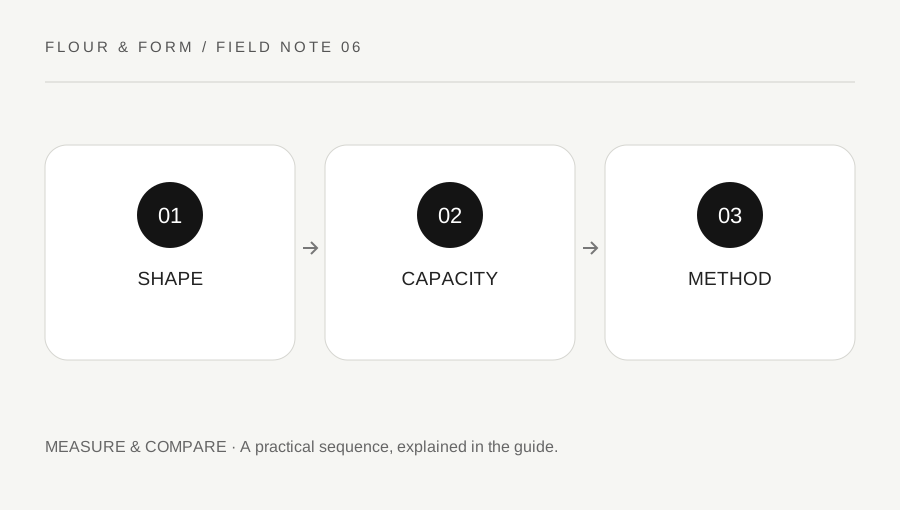
Original explanatory diagram. Examples illustrate a method or decision; they are not claims of personal testing.
Read the recipe’s pan specification
Record length, width and depth, including whether measurements refer to the top opening or another point. A tapered pan has a different volume from a perfect rectangular box with the same top dimensions. A covered pan also introduces a lid and its own intended fill and proofing process.
Use the pan recommended by a verified recipe where possible. King Arthur's pan guidance illustrates why seemingly small size differences can change a loaf's shape. Do not assume a close-looking replacement will produce the same result without checking the recipe and pan instructions.
Use geometry only as a labeled estimate
For two ideal rectangular boxes, multiplying internal length, width and depth gives a volume comparison. If one ideal box measures 20 by 10 by 10 centimetres, its geometric volume is 2,000 cubic centimetres. Another at 25 by 10 by 10 has 2,500, giving a ratio of 1.25.
Real pans can taper, round at corners or use different measuring conventions. The ratio is therefore an explanatory calculation, not a validated dough scaling instruction. Do not fill a real pan to the top because its geometric volume is known. Dough expansion and the recipe's process require appropriate space.
Check material and equipment context
Metal, glass and other pan systems can have different manufacturer instructions. A lid, coating and supported temperature range also matter. Follow the actual recipe and equipment guidance instead of assuming equal volume makes every vessel interchangeable.
Check oven fit and safe handling without crowding other cookware. Do not use a vessel whose heat suitability is unknown. For a larger batch, separate supported pans may be simpler than creating an unverified oversized loaf. A quantity calculation cannot establish the correct baking endpoint for a new shape.
Work through a replacement decision
Suppose the original recipe calls for one specific loaf pan and your pan is wider and shallower. Even if an approximate volume is similar, the dough's depth and exposed surface differ. Ask whether the recipe author supplies an alternate-pan method. If not, use a suitable verified recipe for your pan rather than inventing a universal time correction.
Keep the pan's model and actual measurements in your baking record. If you conduct a real supported comparison, record the result honestly. Do not present a geometric ratio as a tested recipe conversion or a guarantee of the same rise and crumb.
Document the assumption before mixing
Write original pan, proposed pan, measuring method, material and source guidance in a short table. Mark an approximate volume as approximate. Include the intended dough quantity only when supported by the chosen method.
Check this plan before preparing the full batch so excess dough does not force a last-minute unsafe equipment choice. A useful outcome can be deciding to use the original pan or make separate supported portions. Clear pan information keeps a mathematical comparison useful without giving it more authority than it has over an actual baking process.
Take measurements only when cookware is cool and stable. Do not use an unsupported water-capacity test on equipment or coatings whose manufacturer discourages that treatment. The measurement method itself should suit the vessel.
A practical checklist
Choices are saved in this browser. Reset them here or clear this site’s browser storage.
Questions that come up
Can equal-volume pans always be swapped?
No. Shape, material, depth and the recipe process can differ. Use supported alternate-pan guidance rather than volume alone.
Should I fill a pan to its full volume?
No. A geometric capacity is not a dough-fill instruction. Follow the verified recipe and pan guidance, including expansion space.
Does a 1.25 volume ratio validate 1.25 times the dough?
It is only a mathematical comparison. The actual recipe, pan shape, equipment and baking process still need suitable guidance.
References & scope
Background references checked on 18 October 2026. Worked examples and diagrams are original teaching material.