Calculate Seeds, Nuts or Raisins as Inclusions with a Clear Denominator
An inclusion percentage usually needs a stated reference weight. Ten percent of flour is not ten percent of the final dough. Keep the inclusion’s preparation state and any associated liquid visible so the formula remains reproducible.
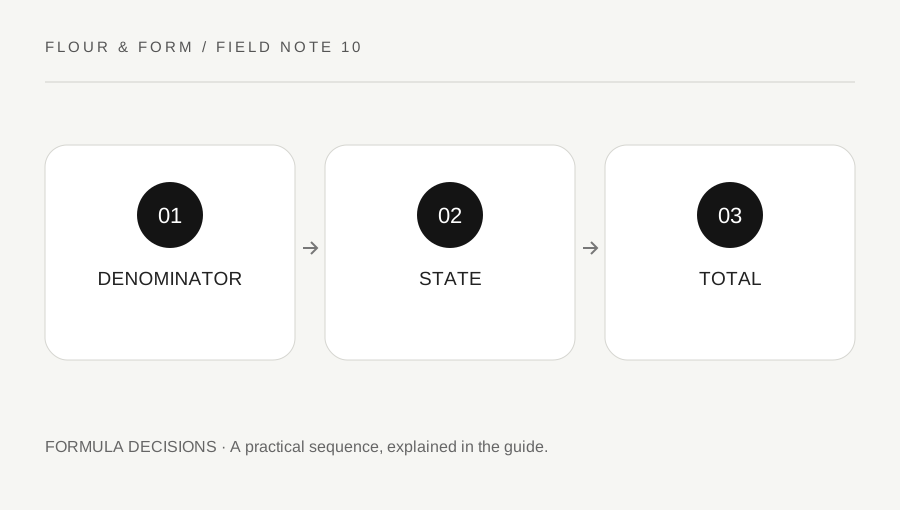
Original explanatory diagram. Examples illustrate a method or decision; they are not claims of personal testing.
State what the percentage means
In an overall baker's-percentage formula, total flour is one hundred percent and each other ingredient is compared with it. If total flour is 500 grams, a ten-percent inclusion is 50 grams. That does not mean the inclusion occupies ten percent of the final combined dough mass.
Other recipes may use a different convention. Read it before translating. A phrase such as add ten percent seeds is incomplete without the denominator. Keep the author's original quantities and method available while you clarify the percentage.
Record the ingredient’s state
Dry raisins, soaked raisins and a drained soaked portion can have different masses. A seed mixture with added liquid also needs its preparation state recorded. Do not assume the weight before and after a preparation step is identical.
Use the verified recipe's soaking, draining and incorporation instructions where applicable. This article does not invent a universal soaking process or moisture correction. If liquid is retained in the dough, account for it under the recipe's stated convention rather than quietly adding it outside the formula.
Work through an illustrative total
Suppose a teaching formula lists 500 grams flour, 350 grams water, 10 grams salt and 50 grams dry inclusion. The inclusion is ten percent of flour. The mathematical total is 910 grams, so the inclusion is about 5.49 percent of that total mass.
The two percentages are not contradictory; they use different denominators. This example is arithmetic rather than a tested bread recipe. It does not establish that every inclusion is suitable at that amount or can be added at the same stage.
Keep dietary and handling details attached
Check actual ingredient and package information for allergens and other dietary needs. A broad label such as mixed seeds does not identify every component. Keep utensils and preparation appropriate for the household's requirements and follow relevant food-handling instructions.
Inclusions can change dough handling and the intended process. Do not assume the lean formula's method remains valid after an arbitrary addition. Use a suitable verified recipe or label a planned experiment honestly, with actual observations recorded only after it is performed.
Audit an inclusion change
Before comparing two versions, keep total flour and the stated inclusion convention fixed. Record ingredient identity, dry or prepared state, any retained liquid and the incorporation stage. If several of these change together, avoid attributing the result only to percentage.
After a genuine bake, describe the observed distribution and handling without claiming an invented taste test. A clear formula can explain why fifty grams was chosen, but it cannot guarantee flavour, texture or loaf strength. The useful calculation keeps the ingredient's amount and preparation state understandable to the next person reading the recipe.
For a second check, compare 50 grams and 75 grams of the same documented dry inclusion with 500 grams flour. Their baker’s percentages are ten and fifteen percent. The difference is five percentage points, while the inclusion mass itself increased by fifty percent relative to its original 50 grams. Those statements use different reference quantities. Write the weights beside the percentages to prevent confusion. If the second version also changes soaking or retained liquid, it is no longer a one-variable inclusion-amount comparison. Keep that change visible and use an appropriate supported method rather than attributing every observed difference to the five-point increase.
A practical checklist
Choices are saved in this browser. Reset them here or clear this site’s browser storage.
Questions that come up
Is ten percent of flour ten percent of dough?
No. Those use different denominators. Calculate and label the intended quantity explicitly.
Can I use soaked and dry weights interchangeably?
No. Preparation can change mass and liquid contribution. Follow the recipe and record the state being weighed.
Does the percentage validate any inclusion?
No. Ingredient properties, dietary requirements and the verified process still matter. The calculation only describes amount.
References & scope
Background references checked on 18 October 2026. Worked examples and diagrams are original teaching material.