Audit a Bread Formula Before Mixing: Totals, Stages and Missing Assumptions
A short pre-mix audit can catch a missing starter contribution, inconsistent unit or mistaken denominator. Check the formula as a quantity system before preparing ingredients. A successful arithmetic audit supports a verified recipe but does not prove the recipe’s process is complete.
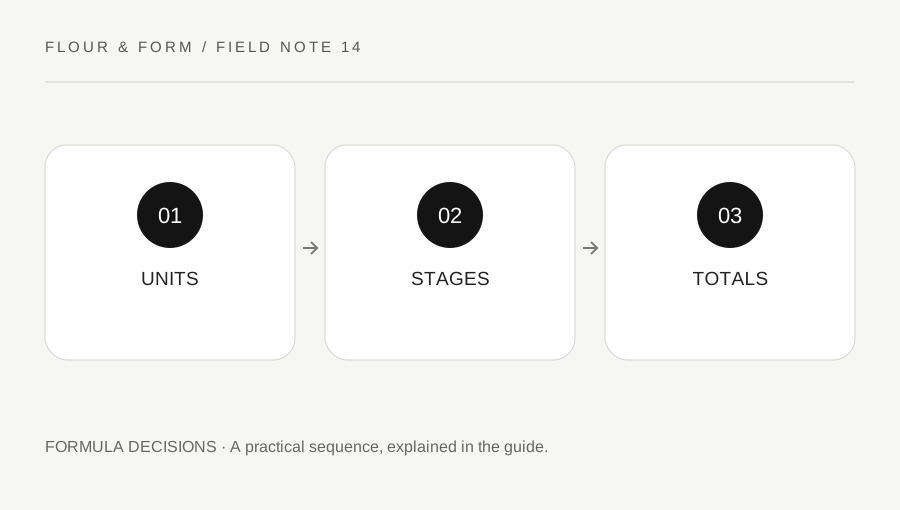
Original explanatory diagram. Examples illustrate a method or decision; they are not claims of personal testing.
Check identity and units
Read every ingredient row and confirm whether it is a weight, volume or count. Use a consistent verified basis before calculating baker's percentages. Keep product identity and preparation state where they matter, such as dry versus soaked inclusions.
Do not assume a copied number retained its original unit. A recipe transcribed from ounces to grams can contain a plausible-looking value with the wrong scale. Preserve the source and test a known row. Clarify missing information before making the full batch.
Trace every stage contribution
List starter or preferment flour and water separately in the overall totals. Check that final-mix additions complete those totals rather than repeating them. If a formula has both an overall table and stage instructions, they should reconcile under the stated convention.
For an illustrative overall target of 500 grams flour and 350 grams water, a starter contributing 100 grams of each leaves 400 grams flour and 250 grams water for final additions. Adding the full 500 and 350 again would create a different formula.
Check percentage and mass sums
Flour categories should sum to one hundred percent of total flour. The full baker's-percentage total normally exceeds one hundred because water and other ingredients are added relative to flour. Do not force every row together to total one hundred as if it were a pie chart of final dough mass.
Add the ingredient weights and compare with the stated theoretical dough total. Keep actual usable dough and cooled loaf weights separate. A difference can be legitimate under a clearly described measurement stage, but it should not be hidden under the same label.
Review assumptions beyond arithmetic
Check starter hydration, flour blend, pan, equipment and measurement limits. Confirm that the verified method supplies the necessary preparation and endpoint guidance. A mathematically balanced ingredient list without a suitable process is not a complete recipe.
If you have changed a quantity, ingredient or vessel, label the plan accordingly. Do not describe an unperformed reformulation as personally tested. A useful audit can identify a question for the recipe author or a reason to use the original supported setup.
Write a concise sign-off note
Record source recipe, unit basis, total flour, total water under its stated convention, stage reconciliation and theoretical mass. Mark unresolved items explicitly. Keep any rounding plan with the measuring sheet so the practical amounts can be compared with the exact calculation.
After a real bake, add actual measured quantities and observations as a separate dated record. Do not overwrite the original plan to make it match the outcome. This keeps the audit useful for the next session and lets another baker see what was known, what was assumed and what was actually observed.
Use one deliberately inconsistent teaching example to practice the audit: total flour stated as 500 grams, but stage flour listed as 100 grams starter flour plus 450 grams final flour. The stages sum to 550 grams, so at least one description needs correction before percentages are trusted. Do not choose the more convenient total without consulting the source. Check water in the same way and keep the discrepancy visible. A successful audit identifies the missing or conflicting statement; it does not require inventing an answer. This habit is particularly useful when a recipe has been copied through several notes or converted between units.
A practical checklist
Choices are saved in this browser. Reset them here or clear this site’s browser storage.
Questions that come up
Should all baker’s percentages add to one hundred?
No. Flour categories add to one hundred percent of total flour. The full ingredient total usually exceeds one hundred because other ingredients are expressed relative to flour.
Does a balanced formula prove the recipe works?
No. Process, equipment, ingredient suitability and proper endpoint guidance still matter. Arithmetic is one part of a complete method.
Should I rewrite the plan after baking?
Keep the original and add an actual-outcome record. This preserves what changed and avoids inventing a level of control the session did not have.
References & scope
Background references checked on 18 October 2026. Worked examples and diagrams are original teaching material.